Ph.D. candidate at Zhejiang University working on 3D perception and autonomous navigation, with interests in LiDAR place recognition, 3D multi-object tracking, and sign-aware map-light navigation.
I am a Ph.D. candidate in Control Science and Engineering at Zhejiang University. My research lies at the intersection of 3D perception, robot localization, and autonomous navigation.
My work focuses on LiDAR place recognition and sparse-map localization, 3D multi-object tracking, and trajectory-level perception for autonomous systems. I am also exploring sign-aware map-light navigation, where robots use environmental signs, semantic landmarks, and human-readable cues for route understanding and progress verification.
I am open to visiting research opportunities and long-term collaborations in robotics, autonomous driving, and embodied navigation.
LiDAR place recognition, loop closure, and sparse-map localization
Sign-aware map-light navigation with semantic landmarks
3D multi-object tracking and trajectory-level perception
Robotics and machine learning
Publications
PB-MOT: Pose-aware Association Boosted Online 3D Multi-Object Tracking Bo Pang, Yang Xu, Jiming Chen, and Liang Li2025 IEEE/RSJ International Conference on Intelligent Robots and Systems (IROS), 2025 [Abs] [Paper] [Project Page] [Video Demo] [Benchmark]
Robotic and autonomous driving platforms necessitate efficient 3D Multi-Object Tracking (MOT) that harmonizes geometric precision, motion robustness, and computational efficiency. Traditional 3D MOT approaches face critical challenges: geometric similarity metrics (e.g., IoU-based) degrade at long ranges with high computational costs, while distance-based methods fail to capture object orientation and shape; the effects of occlusion and the intricate relative ego-object motion degrade tracking performance in dynamic scenes. To this end, we propose PB-MOT, an online framework integrating two key innovations: ego-motion-compensated state estimation that decouples dynamic interactions; and a rotated ellipse association algorithm unifying pose and shape-aware matching with adaptive distance constraints. Evaluations on the KITTI benchmark show that our PB-MOT achieves state-of-the-art performance with a HOTA score of 81.94%, while running at an impressive 2,402.76 FPS on CPU. This enables real-time, high-fidelity perception and tracking for resource-constrained robotic systems.
Manuscripts
PB-MOT++: Extending Pose-aware Association to Trajectory-Centric Offline Optimization Bo Pang, Yang Xu, Jiming Chen, and Liang Li Under revision after first-round review at IEEE Transactions on Intelligent Transportation Systems (T-ITS). [Abs] [Project Page] [Video Demo] [Benchmark]
Reliable perception of dynamic traffic participants is essential for intelligent transportation systems and autonomous driving. While recent advances in 3D multi-object tracking (3D MOT) have substantially improved benchmark performance, trajectory fragmentation and identity inconsistency remain challenging under prolonged occlusion or sparse observations. Existing offline methods partially alleviate these issues through global matching or sequence-level refinement, yet many remain detection-centric and offer limited capability for active trajectory reconstruction. To address this problem, we propose PB-MOT++, a computationally efficient trajectory-centric offline optimization framework that extends our previous pose-aware tracker, PB-MOT. Instead of repeatedly operating on frame-wise detections, PB-MOT++ directly optimizes trajectories through an evidence-first four-stage pipeline: boundary recovery, topology repair, gap completion, and kinematic refinement. By separating structural restoration from geometric smoothing, the proposed framework effectively reduces error propagation and improves long-range trajectory consistency. Extensive experiments on the KITTI benchmark demonstrate the effectiveness of PB-MOT++. Our method achieves state-of-the-art performance with 83.16% HOTA and 87.23% AssA, while maintaining 2351.08 FPS on a CPU-only platform. These results show that high-fidelity offline trajectory optimization can substantially improve tracking quality with minimal computational overhead.
Deployment-oriented LiDAR place recognition with redesigned sparse-reference sampling, stricter keyframe selection, semantic-enhanced map representations, and retrieval evaluation under sparse and incomplete map observations.
Pose-aware online tracking and trajectory-centric offline optimization for autonomous driving perception.
Systems
I have hands-on experience with mobile robot platforms and embedded power electronics, with a focus on connecting sensors, onboard computing, power delivery, and robotic hardware for real-platform perception experiments.



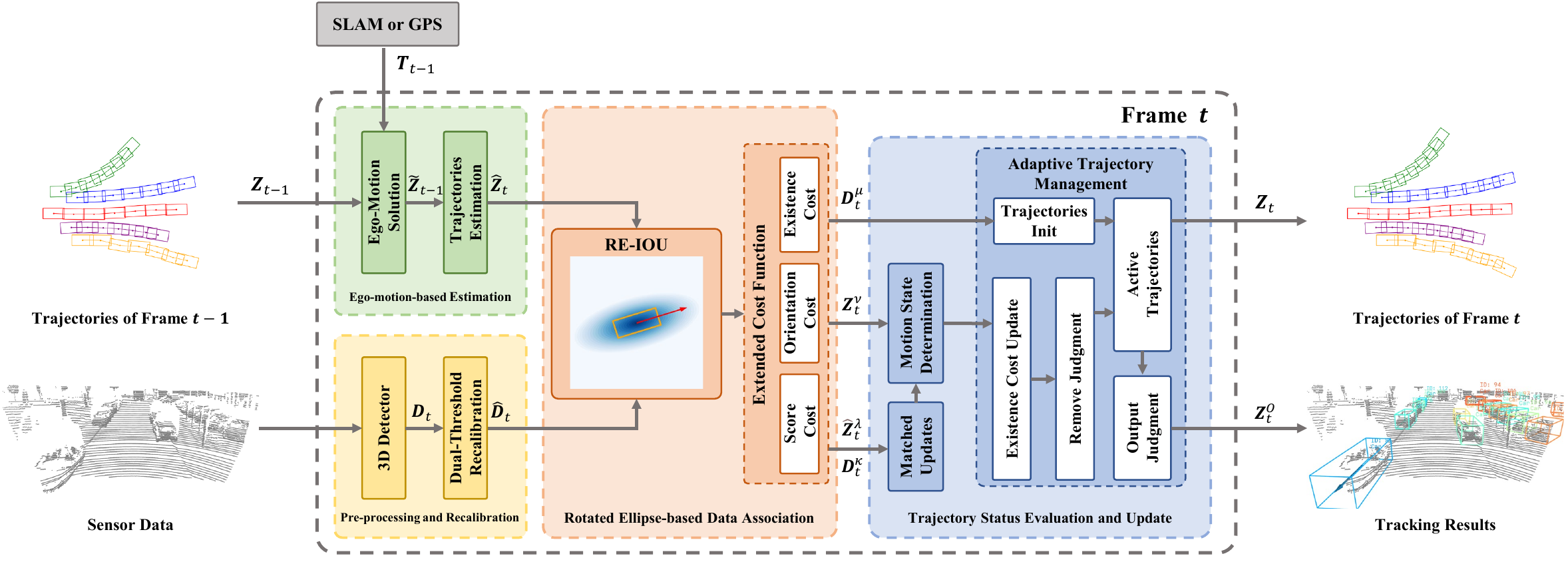 PB-MOT: Pose-aware Association Boosted Online 3D Multi-Object Tracking 2025 IEEE/RSJ International Conference on Intelligent Robots and Systems (IROS), 2025 [Abs] [Paper] [Project Page] [Video Demo] [Benchmark]
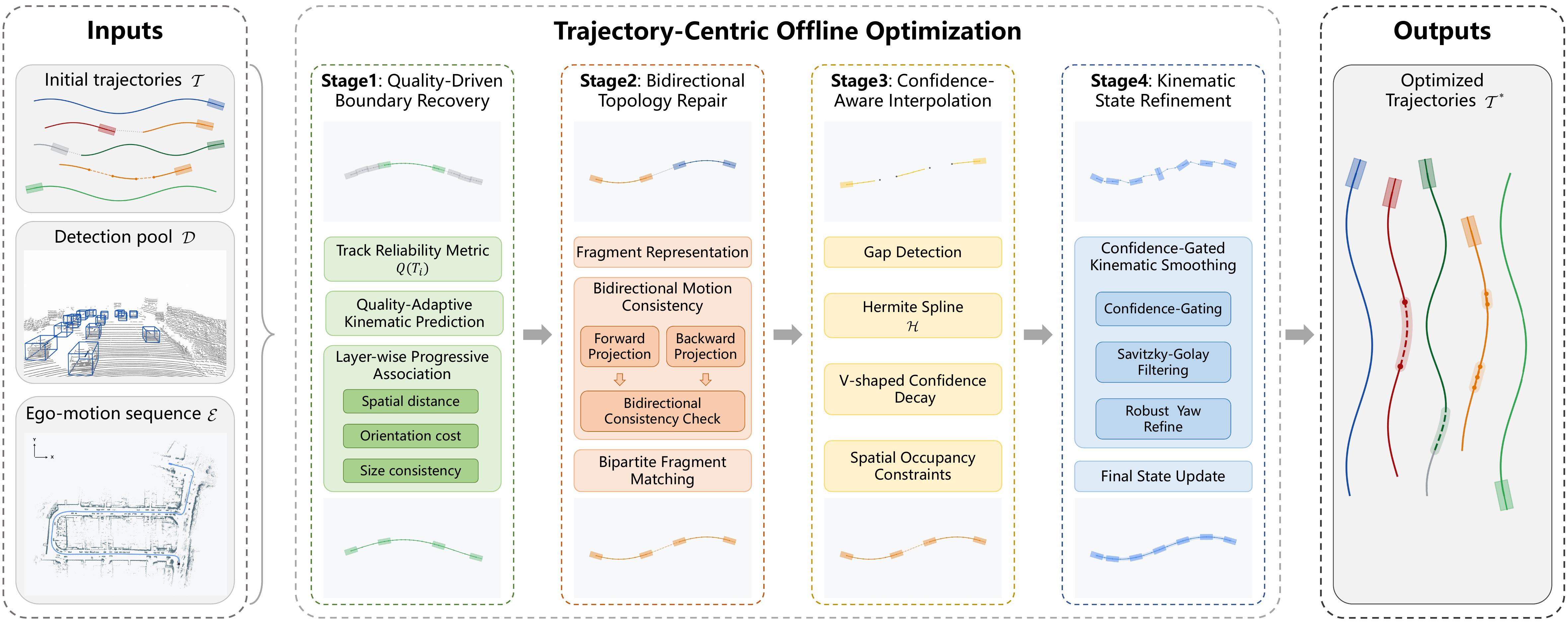 PB-MOT++: Extending Pose-aware Association to Trajectory-Centric Offline Optimization Under revision after first-round review at IEEE Transactions on Intelligent Transportation Systems (T-ITS). [Abs] [Project Page] [Video Demo] [Benchmark]